
Hoteliers notice the light bulb that’s out or the dirty cup left on a table, while designers can spot bad typography from across the room. Work in IT long enough and you develop your own list of things you simply can’t unsee.
With IT Professionals Day coming up in September, we thought we’d share a few of the occupational hazards that come with being an IT engineer. We asked around the iTek team and, as it turns out, switching off isn’t always as easy as closing the laptop.
We look up - A lot!
Most people probably don’t give much thought to where Wi-Fi comes from until it stops working. Our engineers have spent so much time installing and supporting wireless networks so you may find that while everyone else is admiring the room or the view, you find Brad looking at the ceiling.
It’s not nosiness (Well, not entirely), its just that spotting access points has become something of a personal game. Where are they? How many are there? And why, in a building this size, can he only see one?
Brad knows that access point placement can make the difference between reliable business Wi-Fi and that mysterious corner of the building where video calls go to die – so he’s just prepping for the question that frequently comes later in the day “the internet’s broken, does anyone know anything about IT?”.
The comms cabinet
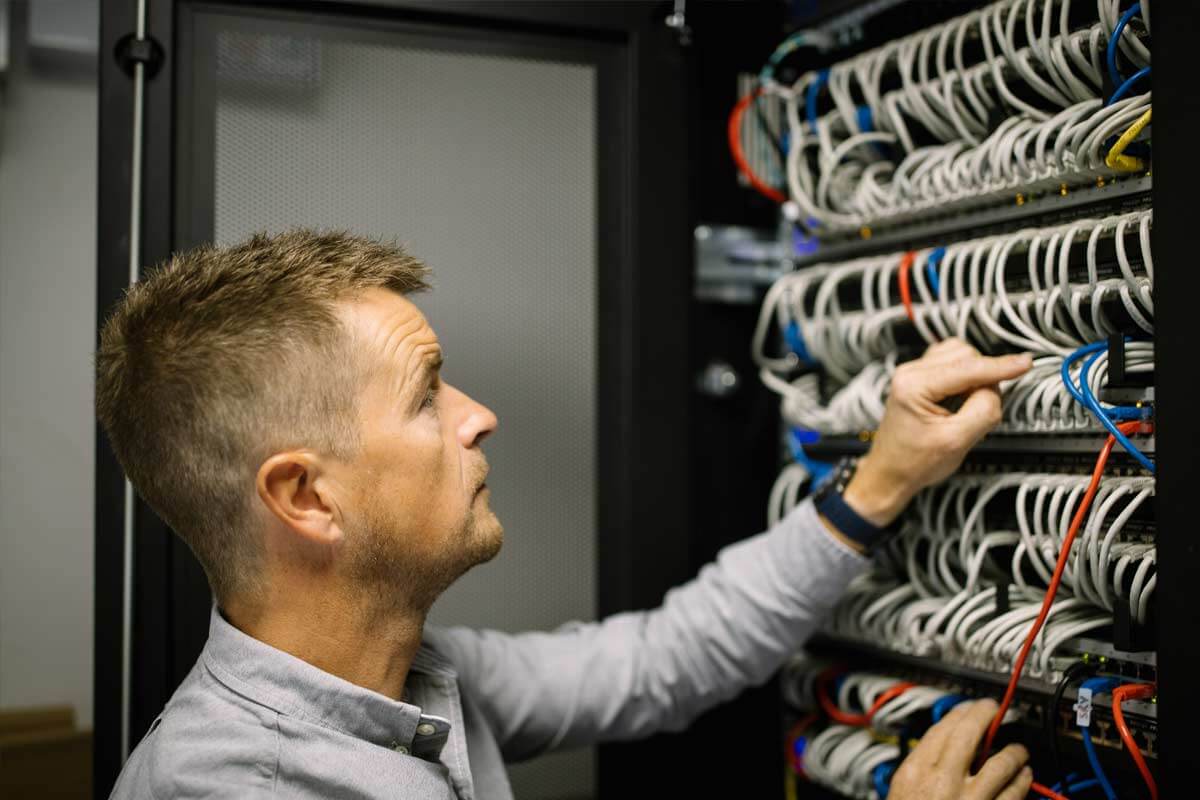
To most people, it’s a cupboard full of wires. To Adam, it’s difficult to pass without a quick look inside.
You can tell a surprising amount about the history of a business from its comms cabinet. Equipment gets added, businesses grow, people move around and new systems are installed, so what started as a beautifully organised setup can become rather more creative over the years.
Some are beautifully organised, some are best approached with patience and a strong cup of tea.
The curious cable
If there’s a cable disappearing through a wall, above a ceiling or into a suspicious-looking hole, most people will walk straight past it. Ben, on the other hand, wants to know where it goes.
We’re not suggesting this makes for particularly exciting conversation on a night out, but when you spend your working week installing network infrastructure, you apparently lose the ability to walk past questionable cabling without investigating. There’s a bit of Scooby-Doo about it, although the iTek version involves more network testers, fewer ghosts and considerably better vans.
Ironically, good cabling shouldn’t be interesting at all. If it’s installed properly, labelled properly and designed with a bit of thought, it should quietly do its job for years without anyone needing to think about it, which is exactly how Ben likes it.
We notice the laptop nobody locked
Someone gets up to make a coffee, disappears into a meeting or goes to find a colleague and leaves their laptop unlocked. Most people won’t give it a second thought, but when you spend your working life thinking about cyber security, it’s surprisingly difficult not to notice.
Good security isn’t always about sophisticated software or dramatic cyber attacks; often, it’s simply about getting the everyday habits right. Locking a computer when you leave your desk takes about a second, but it’s one of those little things that quickly becomes second nature once you’ve worked in IT.
If someone from iTek walks past your desk and casually mentions Windows + L, they’re not judging you… much.
The 'temporary' fix
Every business has at least one. Someone needed a quick solution, everybody was busy and the workaround did exactly what it needed to do at the time. Three years later, nobody quite remembers why it’s there, but everyone agrees that touching it would probably be a bad idea.
The shared login everybody knows, the permissions that have accumulated over the years. The workaround someone invented three years ago that has somehow become an official business process.
Aaron spends much of his time talking to clients on the service desk, and those conversations often reveal that the problem someone is reporting isn’t necessarily the problem that needs fixing. That brings us neatly to…
The things nobody else should have to notice
There is, of course, a point behind all this.
The reason Adam notices the comms cabinet, Brad notices the cabling and Aaron asks another question when someone calls the service desk is because experience changes what you see.
Our clients shouldn’t have to think about most of these things. They need the Wi-Fi to connect, their laptop to work and their systems to be there when they need them.
The iTek team can do the ceiling staring.
So, for IT Professionals Day, here’s to the people who notice the things the rest of us happily walk straight past.
And if Brad goes missing during a site visit, check the comms cabinet first.